Wednesday, August 14, 2013

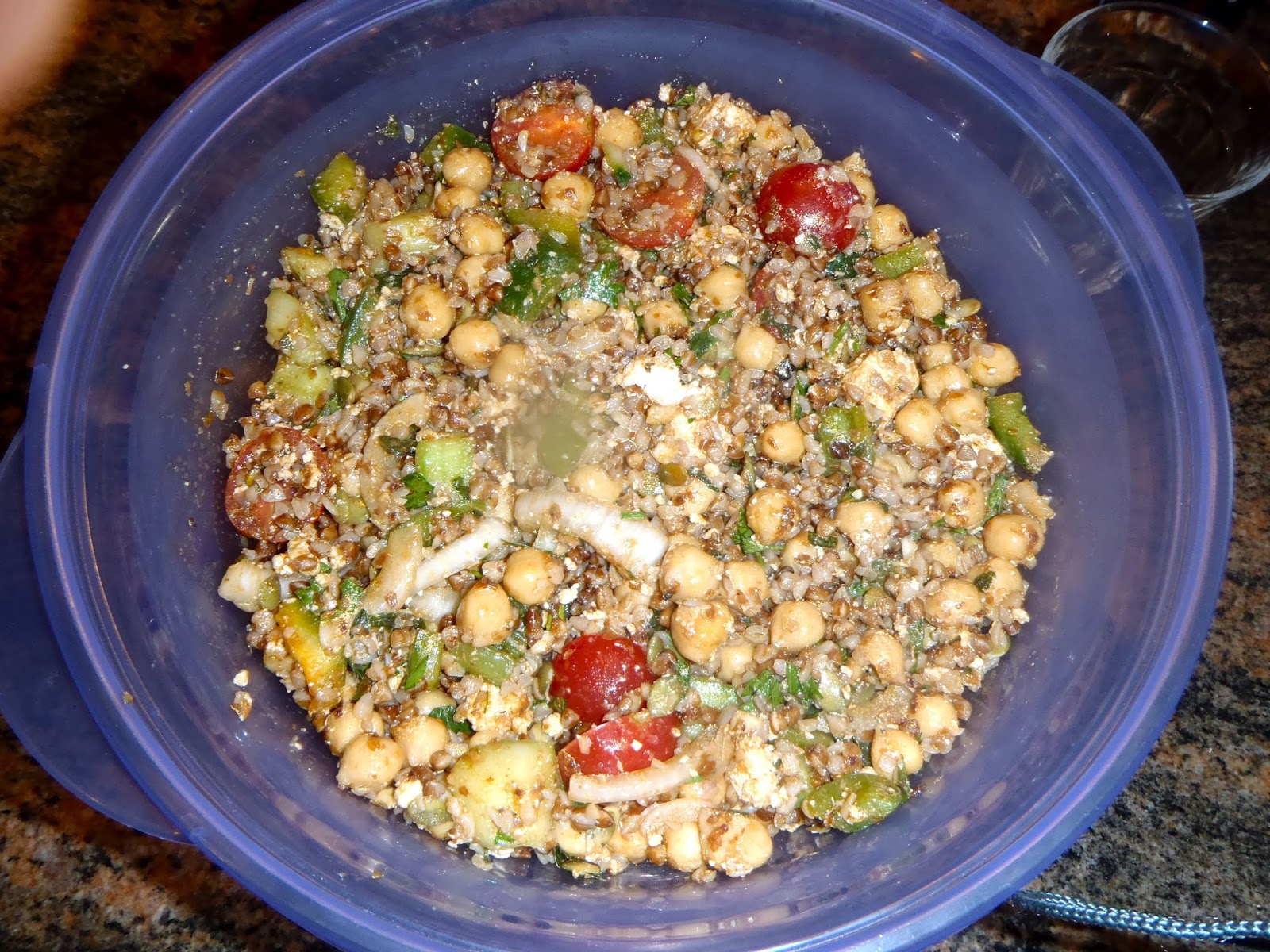
Low-Sodium Kasha Mediterranean Salad with Curd Cheese


Kasha Mediterranean, the Slovenian-inspired salad created by a Facebook friend named Josef, had become one of our favorite dishes. It is a tasty twist on a familiar salad that is normally based on bulgar wheat.  Made with buckwheat instead, it is unusual and perfect for entertaining.

A low-sodium version would be a challenge, because one of the key ingredients is feta cheese.  I resolved to try it with cubes of my homemade salt-free curd cheese, pressed and cubed, then doctored up with paprika, onion, and pumpkin seed oil.  (That recipe, a traditional Slovenian appetizer in its own right, is in the preceding post.)

Without the tang of feta, the salad tasted a little bland.  So I had to make a few adjustments: more spice and a tangier dressing.

For the recipe and the verdict, read on.


Low-Sodium Kasha Mediterranean Salad with Curd Cheese  


Salad:

1 c. dry whole buckwheat groats or kasha, cooked in
1 ½ c.  salted water

1 16 oz can of chickpeas (garbanzo beans), rinsed and drained
6-8 oz salt-free curd cheese (or paneer),  cubed *
4 small/medium tomatoes, diced
1 cucumber, peeled, seeded, and diced
1 green pepper, diced
½ c. red onion, diced (or 4 green onions)
4 T. fresh parsley, minced
black pepper, ground, to taste
smoked paprika, ½ t. or to taste


*The salad ingredients follow the original recipe, except for the substitution of salt-free curd cheese for feta. The cheese will be less bland if it is cubed and marinated with onion, paprika, and pumpkin seed oil.


Dressing (a tangier version):

2 T. olive oil
2 t. pumpkin seed oil
6 T. vinegar
juice of 2 limes
2 T. pomegranate molasses
5 cloves garlic, minced
4 T. fresh mint
1 t. smoked paprika
1 t. hot paprika
black pepper, to taste
1/4 c. pumpkin seeds


If you need more detailed directions for assembling the salad, consult the original recipe.


The verdict?  Well, the flavor was a little different, without the sharp, salty tang of feta.  But the modified salad stands up well,  especially with the intensely flavored dressing.  It's a winner and even more healthy.  Gluten-free, salt-free, and delicious!


Wednesday, August 7, 2013

Curd Cheese with Onion, Paprika, and Pumpkin Seed Oil


This simple but unusual appetizer combines three Slovenian favorites: curd cheese, paprika, and pumpkin seed oil.

I adapted it from a recipe in Janez Bogataj's The Food and Cooking of Slovenia. He calls it Curd Cheese with Onion or Koroška skuta s čebulo.  It is a specialty of Koroška (or Carinthia), a region on the Austrian-Slovenian border that is well-known as a producer of pumpkin seed oil.

Since I wanted to make a salt-free version, I increased the paprika and pepper and added a sprinkle of pumpkin seeds on top.

Traditionally, this tasty-sounding combination is served as a spread on rye bread.  But I had another plan. I wanted to use salt-free curd cheese as a substitute for feta in salads. I worried that my unadorned homemade curd cheese might be a little bland.  I hoped this flavor combination might give it just the right boost.

I made a batch of homemade curd cheese and pressed it overnight to make a firm round. The next day, I cut it into cubes and followed the recipe below.

For the result, read on.


Curd Cheese with Onion, Paprika, and Pumpkin Seed Oil (adapted from Janez Bogataj)

1 cup/ 8 oz curd cheese or farmer cheese, homemade or store-bought, salt-free
1 t. paprika
1/2 onion, finely chopped
freshly ground black pepper to taste
(salt, if desired, to taste)
1 T. pumpkin seed oil
pumpkin seeds, toasted (optional)

For a smooth spread, crumble the curd cheese in a bowl.  To use in a salad or other dish, cut cheese into cubes.

Sprinkle the cheese with onion, paprika, black pepper (and salt, if using.)  For a spread, mash and blend with a spoon.  Or, to retain the shape of the cubes (as I did), just toss the ingredients lightly. Drizzle with pumpkin seed oil.

The verdict?

This does makes a lovely spread on rye bread or whole grain crackers, especially with a sprinkle of pumpkin seeds on top.  But it also worked beautifully in my salt-free version of Kasha Mediterranean Salad.  For the recipe, see the next post.


Tuesday, July 23, 2013

Homemade Curd Cheese (Skuta), Step-by-Step


This is the simplest approach I have found to making curd cheese, otherwise known as farmer cheese, bakers cheese or (if you are Slovenian) as skuta.

For some background on this homestyle delicacy, see my previous post. I arrived at this simple recipe after reviewing many sources on the Internet.  Later on, I discovered another recipe, virtually identical, in Janez Bogataj's The Food and Cooking of Slovenia (2008.)

These recipes appear under a variety of labels.  Curd cheese and farmer cheese seem to have given way to Indian paneer or Italian ricotta in popularity. But they are all variations on a theme: simple, unripened cheeses, in which an acid is used to separate curds from whey.

The recipe below can easily turn into paneer, if enough moisture is pressed out. Technically, it is not really ricotta, although it makes a decent substitute.  Ricotta means "re-cooked" and is based on the whey that is left after making a rennet-based cheese.

This is an approach more than a recipe.  You can experiment and adjust.  The only absolute no-no is ultra-pasteurized milk, because it won't work.

A helpful and amusing comparison of the various approaches to making this style of cheese can be found on Serious Eats, in a Food Lab article, here.  (Yes, the writer refers to his cheese as Five Minute Ricotta and then admits in the small print that it's not really the same thing!)

Ready?  As the Serious Eats article says, it's simple: Heat milk, add acid, drain, enjoy!


Homemade Curd Cheese


8 cups (or use 2 litres) fresh milk (see note)
2-4 T. fresh lemon juice or white vinegar (I have used both)

cheesecloth
colander or strainer
twine

Note:  Any variety of fresh cow's milk should work, as long as it is not ultra-pasteurized. Check the label to be sure.  I use organic milk.


Before you begin: Rinse two layers of cheesecloth in cold water and line a colander or strainer. (In the old days, when salt was sold in a cloth bag, my grandmother used that instead.) Place strainer in large bowl.

Pour milk into a large nonreactive pot or kettle.  Heat slowly, stirring occasionally, until milk is just below the boiling point.  Be careful that bottom doesn't burn.

Turn off heat.  Drizzle 2 tablespoons of lemon juice or vinegar into the milk and stir gently until the curds form. (The curds are the white lumps. The whey is the greenish-yellow liquid.) If curds do not appear, turn the heat back on and slowly drizzle in more lemon juice or vinegar until the curds and whey separate.

After curds form, let the mixture sit undisturbed for 10 minutes.

Ladle the mixture into the lined colander and allow the whey to drain into the bowl, pouring off as needed.  (Save the whey for another use, like bread-making.)

Here we come to a choice point.  How to drain the curds.

The easiest and simplest approach is to let the curds drain for 5 minutes in the colander, remove, and use immediately or refrigerate.  This results in a soft texture that probably resembles cottage cheese or ricotta.  (I have never done it this way because I am not setting out to make five minute ricotta!)

I recommend the more traditional route: Draw the corners of the cheesecloth together, squeeze to remove even more whey, and tie the cheesecloth with twine (or simply tie up the ends of the cheesecloth) to make a firm package of cheese.  You can drain it by simply letting the cheese rest in the colander.  Or you can suspend it from a kitchen faucet or from a spoon placed over a pail. Some sources (like that Slovenian cookbook) suggesting rinsing the curds in cold water before draining.

How long to drain?

The Slovenian cookbook suggests several hours of draining, before unwrapping and refrigerating.  This will give you a semi-solid mass that can be crumbled and used for cooking.  It has a mild, fresh, slightly sweet taste that is perfect for desserts.  It is also ideal for making simple appetizer spreads, like Pumpkin Oil Cheese Spread or a new one I just discovered: Curd Cheese with Onion, or Koroška skuta s čebulo. (Recipe follows.)

Here is the optional final step: Shaping and pressing, which creates the equivalent of paneer.

After an initial draining, twist and squeeze the cheesecloth-wrapped curds into a round, flat cake.  Set it on a rimmed plate.  Top with another plate, and place a heavy weight (like a large can) on top.  Leave in the refrigerator overnight.

When you unwrap the next day, you will find a nice, firm round of white cheese.  When cut into slices, it resembles fresh mozarella and can be used in the same way.  For a delicious appetizer, slice the round of cheese and drizzle with olive oil, balsamic vinegar, and fresh basil leaves.

Are you wondering about the absence of salt?

The salt is omitted in many, if not most, of the traditional recipes for curd cheese and paneer. Others, like that Five Minute Ricotta recipe, do add a little.  But even if you are not trying to cut down on sodium, you are better off leaving out the salt, until you figure out what to do with the finished product.  If the cheese will end up in a sweet dessert, the salt is unnecessary.

That's the beauty of this recipe.  You are fully in control of what goes into it.  It's just milk. Raw or organic, homogenized or not.  Full fat, low fat, or fat free.   Just make sure it's not ultra-pasterized.

And do stick to cow's milk. I got the bright idea of trying to make a salt-free goat cheese, but I couldn't get the milk to curdle properly. So I rescued it by making a sort of grainy yogurt, which I then drained in a coffee filter to make yogurt goat cheese.  It was good, but way too time-consuming.


Below are photos of the cheese-making process, start to finish.

Stay tuned for more recipes using this tasty home-style cheese.


Saturday, July 20, 2013

Fresh Curd Cheese: An Easy, Delicious Salt-Free Staple


Curd cheese. Farmer cheese.  Baker's cheese.  Pot cheese. Hoop cheese.

Ring a bell?

If any of these are familiar ingredients in your kitchen, there is a good chance that your roots are Eastern European or Jewish.  If not, you probably grew up on the East Coast or in parts of the Midwest where people from these communities lived.

When I was growing up in Cleveland and Chicago, a product called "dry curd cottage cheese" was carried by most grocery stores, right alongside the familiar creamy variety. My mother, like most people, used this dry, mild cottage cheese for baking.  Most often, she used it to make the sweet filling for cheese blintzes.  (She never did let on that this was a Slovenian dish as well as a Jewish one!)

As a child, I was fascinated by the taste of dry curd cottage cheese.  I always managed to sneak a little sample, before my mother put it through the food mill and added sugar, vanilla, and eggs.  It was dry, tart and almost aggressively bland.  An empty canvas, waiting to be transformed.

Somewhere along the way, dry curd cottage cheese seems to have disappeared. Sometimes I could find  something similar: firm rectangular blocks of Friendship farmer cheese, shaped like cream cheese but with the taste more like dry curd cottage cheese. But eventually, even farmer cheese became harder to find, especially after we moved to California.

Most often, if I needed to make a cheese filling for either a sweet or savoury dish, I ended up substituting regular cottage cheese or (as the years went on) Italian ricotta.  But it wasn't quite the same.

During my just-completed year of Slovenian cooking, I discovered even more dishes that called for curd cheese fillings.  An elaborate dessert called prekmusrka gibanica or strudel pie.  Savoury dumplings like štruklji and žlifkrofi.  Ajdovi krapi or buckwheat turnovers.  And even a nice cheese spread with pumpkin seed oil.  At first, I just used ricotta, and it was fine.

But I was thrilled to find a wonderful local source of farmer cheese in a shop right around the corner. It is called Farmers Cheese, Russian style, made by Belfiore Cheese Company in Berkeley.  It comes in rectangular tubs.  This cheese has a delicious tang and is a little moister than the dry curd cottage cheese or the block-style farmer cheese I used to be able to find.  It became my baking cheese of choice for ethnic dishes.


Since I now had a fine local source, it would never have occurred to me to consider making my own curd cheese if I hadn't taken on the challenge of salt-free cooking.

It was all because of Sodium Girl (of course!) who had written a funny but informative blog post about paneer, the Indian cheese that shows up as firm white cubes in any number of delicious vegetarian dishes.  She had become a big fan of paneer because, unlike almost all other cheeses, it is usually prepared without added salt.  She also noted that it is easy to make at home and included a link to a simple recipe. (Take a look at her full post, Paneer is Here.)

So that got me combing the Internet for paneer recipes.  And I quickly learned that paneer is one of a family of simple, uncured homestyle cheeses. Remember Little Miss Muffet who sat on a tuffet, eating her curds and whey?  Well, these cheeses are the curds minus the whey.

Farmer cheese and pot cheese.  Russian tvorog and Indian paneer.  Mexican quesco fresco and Slovenian skuta.  Every culture seems to have a version.  They are variations on a theme. They all begin the same way.  Milk is heated, and then an acid (usually lemon juice or vinegar) is stirred in, to separate the curds and whey.  In other words, the milk curdles.  The curds are drained and either left as dry crumbles or pressed into a firmer cake or block.

Sometimes a cultured milk product, like yogurt or buttermilk, is added along with the vinegar or lemon juice.  There are various degrees of sitting, heating, and pressing involved.  Some recipes do call for a little salt at the beginning, but most seem to wait until the cheese is in its final form before adding.

Salt-free cheese.  It seemed too good to be true. I had assumed that any farmer cheese or curd cheese I bought would have at least some added salt.   Besides, I was intrigued. So I set out to make my own.

As it turns out, I was wrong to assume that commercially-made farmer cheese and curd cheese always contain added salt. Belfiore, my local brand, does not.  But I'm glad I didn't discover this until recently, or I might not have set off on my cheese-making adventures.

Here is an interesting article about the history, disappearance and re-emergence of farmer cheese, with a nice mention of my two favorite brands:  New York-based Friendship and Berkeley's own Belfiore.

Ready to try making curd cheese yourself?  Take a look at the next post for a step-by-step recipe.


Tuesday, June 25, 2013

Healthy Slovenian Buckwheat Baby for Father's Day


Everyone loves the eggy, skillet-baked pancake that most Americans call a Dutch Baby.

What happens if you add a little buckwheat flour?

I wish I could claim this as my own Slovenian-inspired innovation.

But the credit goes to Deb, over at the popular Smitten Kitten blog.  She paired the pancake with a rich, salt-kissed caramel topping.  No surprise that her recipe for Buckwheat Baby with Salted Caramel Syrup has spread like wildfire.

The dish looked delectable. The addition of buckwheat flour spoke to my Slovenian heart. In fact, it seemed reminiscent of my own creation, Buckwheat Breakfast Crumbles.  But with salt in the pancake and salt in the topping, this Baby was not exactly a good fit for our new low-sodium lifestyle.

So I decided to make a healthy version for Father's Day. No salt.  Less fat.  I had planned to use vegetable oil instead of butter, but my husband suggested we try his latest discovery: coconut oil. And instead of that decadent salty caramel sauce, I improvised a nice light fruit topping: strawberries and blueberries mixed with apricot preserves, almonds, and touch of amaretto.  Not too shabby.

For the batter, I followed the basic flour-milk-egg proportions suggested in Smitten Kitten. I eliminated the salt and added brown sugar and vanilla as a flavor boost.  I also increased the quantities by half, since I thought that Baby might puff up a little more sucessfully.

I decided to call my adaptation a Slovenian Buckwheat Baby Pancake.


Slovenian Buckwheat Baby Pancake  (a healthy adaptation from Smitten Kitten)

Pancake
4-1/2 tablespoons buckwheat flour
4-1/2 tablespoons all-purpose flour
1-1/2 tablespoons brown sugar
3/4 cup lowfat milk
1/2 t. vanilla
3 large eggs
2 tablespoons coconut oil


Fruit Topping
strawberries, cut up
blueberries
low-sugar apricot preserves, to taste
whole almonds
splash of amaretto

Confectioner's sugar for topping.


For fruit topping: Mix ingredients together in whatever proportions you wish.  Let sit so flavors can blend. 

For the pancake, mix all ingredients together in a shaker (as I did) or by beating in a bowl until smooth.   Heat coconut oil in a cast iron skillet on top of the stove until hot.  Pour in the batter and place in a 400 degree oven.  Bake for 15 to 17 minutes until puffed and golden.

Remove pancake from the oven.  Sprinkle with confectioners sugar.

Cut into wedges and serve with fruit topping and (if desired) Greek yogurt on the side.

For the verdict, read on.


This was delicious!  The buckwheat provided a nice hearty tang. The coconut oil allowed the pancake to brown just right and it added a mild, intriguing flavor. (No wonder the New York Times calls it the new darling of the health food world!) The fruit topping was light and flavorful without being overwhelming.  And best of all: no added salt. 

Another LoSoSlo success!


Wednesday, June 19, 2013

Smoked Paprika Chicken Breasts, a Low-Sodium Update


Back in August, I discovered an online recipe for smoked paprika chicken. This easy, elegant grilled entree seemed very much in the Slovenian spirit. I adapted the recipe slightly and served it as part of my Week 31 Dinner.  Since then, it had become one of our favorites.

The prep is easy.  Boneless chicken is pounded thin and then brushed with a simple paste of oil, smoked paprika and seasoned salt.  Lots of it.

The Shiksa in the Kitchen, whose version of the dish first inspired me, cautions that it is important to not skimp on the salt. Don't worry, she says, the finished dish won't taste too salty.

By my old standards, she was right. But that was then and this is now, as the old cliché goes.  The salt had to go.

I wasn't sure this particular dish could survive without the salt.  I wasn't  too worried about the change in taste.  But I was concerned that the salt might be an essential component of the paste. It provided texture that the powdery paprika by itself did not.  I suspected it might play a role in tenderizing the chicken or sealing in the juice.

But it was worth a chance.  So I made the dish with the easiest possible substitution: A commercially prepared no-salt seasoning mix.

I am not a big believer in pre-mixed seasoning blends.  We rarely use them.  But I happened to have one on hand: Mrs. Dash salt-free garlic and herb blend.  So that's what I used.

The verdict?

The chicken cooked beautifully on the grill.  We sliced it and arranged it on a platter.   My husband had prepared two salt-free side dishes: a mixed green salad and kasha with mushrooms.

As always, the chicken was moist and delicious.  Everything was low-sodium Slovenian. Or at least Slovenian-inspired.

Whatever you call it, we enjoyed another LoSoSlo feast!


Smoked Paprika Chicken Breasts, salt-free

2 whole skinless, boneless chicken breasts (about 1 lb)
1 T. smoked paprika
1 ½ T. olive oil
2 t. no-salt seasoning mix (I used Mrs. Dash garlic and herb blend)

Place chicken breasts between 2 layers of plastic wrap. Pound with the side of a sturdy plate (or, if you have one, a meat mallet) to flatten into a thin, even layer. Mix the paprika, oil, and no-salt seasoning mix into a paste. Rub into both sides of chicken. Refrigerate for a half hour.

Grill, turning when browned on one side.  (Or use a broiler.) When done, remove to a platter. Let cool slightly. Slice into strips and serve.

Saturday, June 1, 2013

Balkan Cevapcici vs. American Burger & Fries: A Sodium Throwdown

Low-sodium cevapcici feast


cevapcici

Big Mac (source: Wikipedia)  


A hamburger on a bun, the all-American fast food?  Or how about the Balkan contender, cevapcici with flatbread?  What should you choose, if you are watching your sodium intake?

The raw materials are the same.  Ground meat and white flour.  Both are relatively inoffensive, salt-wise.

Plain ground meat (whatever the source) does have naturally occurring sodium, but not much: 60-75 mg in a quarter pound, before cooking.  Whatever the problems with meat consumption (and there are many), salt is not one of them.    

Flour has negligible sodium. But bread is usually made with added salt, so it can add up. The typical hamburger bun or a medium pita both contain 200+ mg of sodium.  The count drops to almost 0, if you can find commercially made salt-free pita, or if you follow my salt-free lepinja recipe.  

In theory, a simple meal of grilled meat and plain bread doesn't have to be salt-laden.  But the reality is different. 

First, a reminder: The recommended daily sodium limits are no more than 2300 mg a day. Most adults should aim for 1500 mg.  To be considered low sodium, a meal should be under 450 mg.

Nutritional profiles for fast foods are easy to find.  McDonald's is particularly obliging. They spell it all out here.  

It is pretty shocking.

A McDonald's Big Mac contains 970 mg of sodium.  A large order of fries is 350 mg.  That is practically your entire daily salt quota in a single meal.  What if you skip the fries and have a small side salad? That's just 10 mg of sodium.  Unless you add a packet of low calorie balsamic vinaigrette dressing, which adds an astonishing 470 mg of sodium.

Considering a Big Mac alternative?  There are 1490 mg of sodium in a chicken-bacon wrap or in a bacon, egg and cheese bagel. (Please note: McDonald's is no worse than most other popular fast food chains.  If nothing else, they are transparent.)

So where does all the sodium sneak in?

Salt is often added to the ground meat mixture before cooking, whether the end product is a burger or cevapcici.  When you do the cooking yourself, it is easy enough to leave it out.  And be sure to skip the baking soda, if you are aiming for low sodium cevapcici.

The real difference between the American and the Balkan fast food meal?  It's in the add-ons.   The accompaniments and the side dishes.
  

Burger and Fries (source: Wikipedia)

What goes with cevapcici, besides flatbread?  The little sausages are traditionally served with ajvar, a red pepper relish, either homemade or the commercial variety.  Along with that, there is kajmak, a sort of clotted cream that is hard to find in the United States. Labne or Greek yogurt make good substitutes.  Grilled onions and peppers, along with tart raw vegetable salads, will often round out the meal.  

But consider the American hamburger.  It  arrives with a double helping of starch, a bun and salty French fries.  Then there are the high sodium garnishes: a slice of processed cheese, dill pickle slices, catsup, and perhaps other "special sauces."  If there is coleslaw or a green salad, it is usually saturated with a high sodium dressing.  

The Balkan meal wins, hands down.  It is lower in sodium.  Probably lower in fat and calories.  More flavorful.  And it is real food!

To inspire you, below are some sodium numbers, with the preferred choices in bold.

Na Zdravje!  To your health! 


Sodium Counts for Burger and Cevapcici Accompaniments

1 oz slice of American (processed) cheese   396 mg       
1/4 cup Greek yogurt                                   31 mg
1/4 cup kajmak (clotted cream)                   48 mg    

McDonald's Special Sauce                           unknown (but high)
1 T. catsup                                                    150 mg
1 T. ajvar (red pepper relish)                      50 mg    

l hamburger bun                                           200+ mg
1 medium pita                                               200+ mg  
1 salt-free pita                                                 0
                      
1 medium dill pickle                                     560 mg
1 whole cucumber                                       6 mg

McDonald's fries, medium                            270 mg 
McDonald's fries, medium, no salt                  55 mg