Saturday, October 26, 2013

Chicken Stew, Slovenian-Style and Salt-Free


"Obara?"  Mia's eyes twinkled. "That means you can put anything in it!"

I was in my favorite spot at San Francisco's Slovenian Hall: the small upstairs library, hanging out with Mia, who is originally from Slovenia.  She is a warm, charming woman who retired a few years ago from her position as a university librarian.  Mia always seems amused by my ethnic cooking adventures.  She even recalled my disaster with žganci and had brought back some buckwheat flour from her most recent trip to Slovenia, just in case that was the source of my problem.

So now I had it on good authority:  The Slovenian stew known as obrara or ajmoht really is an "everything-but-the-kitchen-sink" dish.  That was a good description of my most recent version.  It had to be salt-free, so I tried to boost the flavor with as many additions as possible, without departing too much from tradition.

Obara or ajmoht can vary, depending on the meat used and the assortment of vegetables added.  The distinctive element, at least to the American palate, is a certain Slovenian tang, thanks to a brown roux and sometimes a tart addition like lemon zest, wine, or vinegar.

It all started with my mother's recollection of a childhood dish she called "aye-macht," a sort of roux-thickened veal soup.  For my first attempt at recreating the dish, Chicken Ajmoht I, I used a simple recipe from the Progressive Slovene Women of America.  I also tried to make žganci as an accompaniment, but the little dumplings ended up as buckwheat polenta.

For my next attempt, Chicken Ajmoht II, I consulted a couple of additional sources, The Food and Cooking of Eastern Europe and Slovenian Cookery.  That's when I started adding wine.

This time around, I had my newest cookbook to consider, Janez Bogataj's The Food and Cooking of Slovenia.  I also had a sous-chef, since my husband volunteered to do the actual cooking.

For the result, read on.


Chicken Stew, Slovenian-Style and Salt-Free (chicken ajmoht or obara)

2 whole boneless chicken breasts (skin on), cut up
olive oil to brown chicken
1 onion, chopped
3 cloves garlic, minced
1 T. butter
2 T. olive oil
2 T. flour
1 c. white wine
2  ribs celery, chopped
1 leek, bulb and a bit of green, soaked well and sliced
2 carrots, peeled and  sliced
1/2 c. cauliflower florets
2 potatoes, peeled and cut up
water to  cover
peel of 1 lemon, grated
1 T. fresh marjoram, minced
1 T. fresh thyme, minced
1 cup peas, fresh or frozen
4 T. fresh parsley, minced
pepper to taste
optional: no-salt seasoning (or salt) to taste

Heat oil in a Dutch oven or large deep skillet. Brown chicken and set aside.  Add onion and garlic and brown.  Now make a roux: Add 1 T. butter, 2 T. olive oil, and 2 T. flour and cook until brown.  Add wine and celery, leek and carrots.  Add water to cover.  Add lemon and seasonings. Cover and simmer for 30 minutes.  Add potatoes and simmer until tender.  Taste and adjust seasonings.  Sprinkle with additional parsley and serve.


The verdict?  The mixture of flavors was delicious. My husband had a generous hand with the wine, which gave the dish a particular zest.  He did leave the chicken in larger chunks than I might have, and there seemed to be less liquid than in my previous versions.  But you can easily adjust for a saucier dish.  All in all, another LoSoSlo winner!


Monday, October 14, 2013

Bograč, Spicy and Salt-Free Goulash Soup


Bograč, Slovenia's spicy goulash soup, seemed like a good candidate for a low-sodium makeover.  I had made it twice before, with slightly different seasoning variations each time.

To compensate for the lack of salt, I figured I'd better season to the max, this time around. I used the complete array of vegetables and flavorings from the two previous versions, but increased the quantities.  I did this the easy way: by cutting down on the meat and keeping everything else constant.

For the recipe and the verdict, read on.


Bograč, Spicy and Salt-Free Goulash Soup

1/2 lb. beef stew meat, cubed
1/2 lb. pork stew meat, cubed
1 large onion, sliced
2 large cloves garlic, chopped
1 oz. dried porcini mushrooms, soaked and prepared as directed
1 green pepper, sliced
1 red pepper, sliced
1 t. caraway seed
1 T. paprika (half hot, half smoked)
2 t. fresh marjoram
black pepper to taste
small hot pepper, a few slices, minced (optional)
(salt-optional)
1/4 c. fresh parsley, minced
½ c. crushed tomatoes
1 lb. potatoes, cut in chunks
water to cover
1/4 c. red wine
olive oil


Before beginning, prepare dried mushrooms as instructed on package, or use these directions: Soak in warm water until softened. Drain, cover with fresh water, and simmer until tender.    

Brown onion in olive oil, using a large pot or Dutch oven. Add garlic and continue to brown. Remove to another bowl. Add meats to oil left in pot and brown. Add the peppers and spices and continue to brown. Return onion and garlic to the pot. Add re-hydrated dried mushrooms (with or without cooking liquid), crushed tomatoes and enough water to cover. Simmer until meat is tender and almost done. Add potatoes and wine and simmer another hour. Taste and adjust seasonings. Serve garnished with additional parsley.


The verdict:  Delicious!  The first night, we served the bograč with cooked greens alongside.  The second night, my husband also made some cooked kasha.  The earthy flavor went particularly well with the spicy goulash.

This version did come out more like a thick stew than a soup.  That can be adjusted easily by adding more water, or even some extra wine!


Tuesday, October 1, 2013

Curd Cheese Pancakes, Russian-style


My obsession with curd cheese and farmer cheese was still going strong.

The latest twist: We had just picked up some authentic tvarog at a Russian grocery in San Francisco.  It turned out to be very much like the version made by Belfiore, a small cheese-making company based in Berkeley, my home town.

I knew the perfect way to use that cheese. Pancakes.

A few months earlier, my Cajun band had a gig at a local farmers' market. During the break, I discovered a Russian Jewish vendor with a variety of traditional homemade delicacies for sale. My favorites were the cheese pancakes, or syrniki in Russian. They were unlike any cottage cheese pancakes I had tried before: sweet, thick and substantial. More like cheese patties.

There are many recipes available for pancakes made with cottage cheese or sometimes ricotta. These pancakes have long been a popular high-protein dish for dieters, since they are typically heavy on the cheese and egg, with just a little flour.

But the Russian take on the dish was new to me.  I searched out a number of recipes for cheese pancakes and discovered that many Eastern and Central European groups make them. But not the Slovenians. The closest I could find were boiled cheese dumplings. (Slovenian "cheese pancakes" turned out to be blintzes.)

So I decided to stick to recipes for Russian cheese pancakes.  I ended up with a variation of a recipe I found on an NPR site, which they had adapted from a Russian chef.  I worked out a single serving adaptation.

The NPR recipe is here.

For my version, along with the verdict, read on.


Curd Cheese Pancakes, Russian-Style


To make one generous serving:

1/2 cup farmer cheese (Russian-style is best), curd cheese, or ricotta
1 egg
1 T. sugar
1-2 T. flour
a few drops of vanilla
squeeze of lemon juice
(optional: pinch of baking soda, regular or low sodium)


Mix all the ingredients together.   Heat oil or butter in a skillet.   Drop batter by rounded tablespoons into skillet.  When brown on one side, turn.  Serve with honey or syrup, yogurt, and fresh fruit.


The verdict?  Very tasty.   The recipe made a generous serving, which I managed to finish with no leftovers. I didn't miss the salt at all.

It was not quite what I remembered from the Russian vendor at the farmers' market. I suspect the Russian man used a larger proportion of cheese relative to the egg and flour.

The next time, I'll make a larger recipe and experiment with the proportions.   I may also try my hand at making homemade farmer cheese that duplicates that Russian tang!

Update: A year-and-a-half later, I finally perfected this dish--and I discovered a recipe for syrniki in one of my vintage Slovenian cookbooks! To read about it, go here.


Saturday, September 21, 2013

Buckwheat Cheesecake for the Fourth of July Pie Contest


It was time for the annual neighborhood Fourth of July potluck.  For the second time, there would be a pie-baking contest.

Last year's entry, prekmurska gibanica, had been a success.  I came in third out of eight, a modest but respectable showing, especially since the fabled Slovenian dessert wasn't exactly a pie by American standards.  The elaborate layered "strudel pie" had aroused plenty of interest and it did taste wonderful.

For an encore, I had in mind another unusual dish that was not quite a pie.  Buckwheat cheesecake. I'd had my eye on the recipe for the past year and had been waiting for the right occasion.  It looked simple and it fit right in with my recent curd cheese/farmer cheese obsession.   And it was already salt-free.

The original recipe, called ajdova zlevanka, appears in The Food and Cooking of Slovenia (2008) by master chef Janez Bogataj.  (It is reprinted here, in a Milwaukee newspaper.)

I made just a few additions to the original recipe: sugar and ginger in the pastry crust and a grating of lemon rind in the filling.  The foundation of the dish was a Russian-style farmer cheese I can buy locally. Its wonderful tang probably comes from a "culturing" step that is omitted in  my simple homemade curd cheese.  In the spirit of the holiday, I devised a  red-white-and-blue fruit topping: blueberries and strawberries mixed with a simple glaze.

For the results (of the recipe and the competition) read on!


Buckwheat Cheesecake   (adapted from Janez Bogataj's Ajdova Zlevanka)

1 c. (scant) buckwheat flour
1 c. (scant) white flour
2 T. sugar
pinch of ginger
1/2 c. butter
1 egg yolk, beaten
cold water to bind, about 1-2 T.

1-1/4 lb. or 500 g. farmer cheese or curd cheese
2/3 c. superfine sugar
3 eggs, lightly beaten
1 t. grated lemon rind
2/3 c. sour cream, divided
2 T. plain flour

For topping:  Fresh fruit, plain or mixed with a simple glaze (see below)


Grease an 8 inch tart pan with a removable bottom or a springform pan.

For the crust:  Sift flours, sugar and ginger into bowl. Cut in butter.  Stir in egg yolk and enough water to bind the mixture. Blend lightly and form into a ball.  Wrap in plastic wrap and refrigerate for 20 minutes.

Roll out dough and line the pan.   Line pastry with parchment or foil and fill with rice or beans to blind-bake.  (I used whole buckwheat!)  Bake for 10 minutes at 375 degrees. Let cool.

For the filling: Mix cheese and sugar.  Add eggs, lemon rind, and two-thirds of the sour cream and beat together.  Sift flour over surface and fold in.

Pour filling into crust-lined pan.  Spread remaining sour cream over the top in a thin layer.

Bake for 40 minutes at 375 degrees until lightly set.  Let cool and top with fresh fruit or glaze before cutting.


I baked the cheesecake in the late morning and set it out to cool.  I hadn't been successful in spreading that thick sour cream, so the top was covered with little white dabs.  And the buckwheat crust looked more rustic than elegant.  Not a beautiful dish.

No matter.  I would cover it with a simple fruit topping I improvised.


Simple Fruit Topping

fresh strawberries and blueberries
strawberry preserves and orange marmalade, equal parts
splash of lemon juice
spash of kirsch or other liqueur

Wash and dry fresh strawberries and blueberries and set aside.  In a small saucepan, mix the preserves. Warm slowly over low heat until mixture melts.  Add lemon juice and kirsch to taste.  Gently mix fresh fruit with glaze and arrange on top of cheesecake.

Now my pie entry looked more than presentable.  On to the contest.


When I arrived at our neighbor's house,  I realized the competition would be stiff.  The field was a little larger this year.  And everyone else seemed to have gone creative with the toppings and decorations.  My red-white-and-blue brainstorm wasn't exactly unique.

But the proof would be in the eating.


When I cut into that buckwheat cheesecake, my heart sank.  The filling was soft, especially in the middle.  Those thin slices looked more like pudding!  And the crust was hard to cut.

I bit in and was disappointed.  The buckwheat crust was tough and dry.  The filling was pleasant but bland.

I came in second-to-the-last in the pie ranking.  No prize for me this year. Of course, I had refrained from voting for myself this time. Not out of modesty but simply as an honest assessment. This dish was not a winner.

But guess what?  The next day, after thorough chilling, the filling had firmed up perfectly. And it tasted delicious, with the tart Russian-style farmer cheese and the touch of lemon.

The crust wasn't great.  My mistake, I think, was that I didn't pay enough attention to the "scant" part of the directions. Because the dough had been too dry at first, I had added more water and probably overworked the pastry.

Next time, I will probably use just 3/4 cup of each flour for a more tender crust.  On top, I might use more sour cream and thin it with a little milk for ease of spreading.

The original recipe indicates that the cheesecake can be served warm.  But I still recommend thorough chilling, to bring out the flavor of the filling.

There is also a savory alternative, with salt and pepper rather than sugar in the filling. Interesting, but probably tough to do without the salt.   I'll probably concentrate on perfecting this unusual and promising dessert version.

Update from November 2014: The savory version, with a much-improved crust, was a success!


Friday, August 30, 2013

Farmer Cheese, Honey-Tahini and Blueberry Breakfast Toast


Our house is undergoing renovations.  For the past month, the kitchen has been dismantled. Refrigerator is in the dining room.  Stove is disconnected.  To cook, we have to rely on the microwave, toaster oven, and outdoor grill.  To shower, we have to go around to the attached studio out back. It feels like camping.

This morning, I was tired of cereal.  I wanted something fast, tasty, salt free and (if possible) Slovenian in spirit.

I am not sure if this tasty breakfast toast qualifies as Slovenian-inspired.  At least it is Eastern Euro-inspired, with honey-tahini spread from Kosovo and Russian-style farmer cheese (made by the Belfiore Company, right here in Berkeley.)    It also qualifies as low-sodium, with salt-free bread and farmer cheese and (I assume) tahini-honey spread without any salt.


Farmer cheese, Honey-Tahini, and Blueberry Breakfast Toast

1 slice whole grain bread (low sodium preferred!)
curd cheese or farmer cheese
honey-tahini spread
fresh blueberries

Toast bread.  Spread with a thin layer of honey-tahini spread.  Add a layer of cheese. Top with a sprinkle of fresh blueberries.  Finish with a drizzle of honey-tahini spread.

The verdict:  Easy, healthy and so delicious it tastes like dessert!

Enjoy!


Wednesday, August 14, 2013

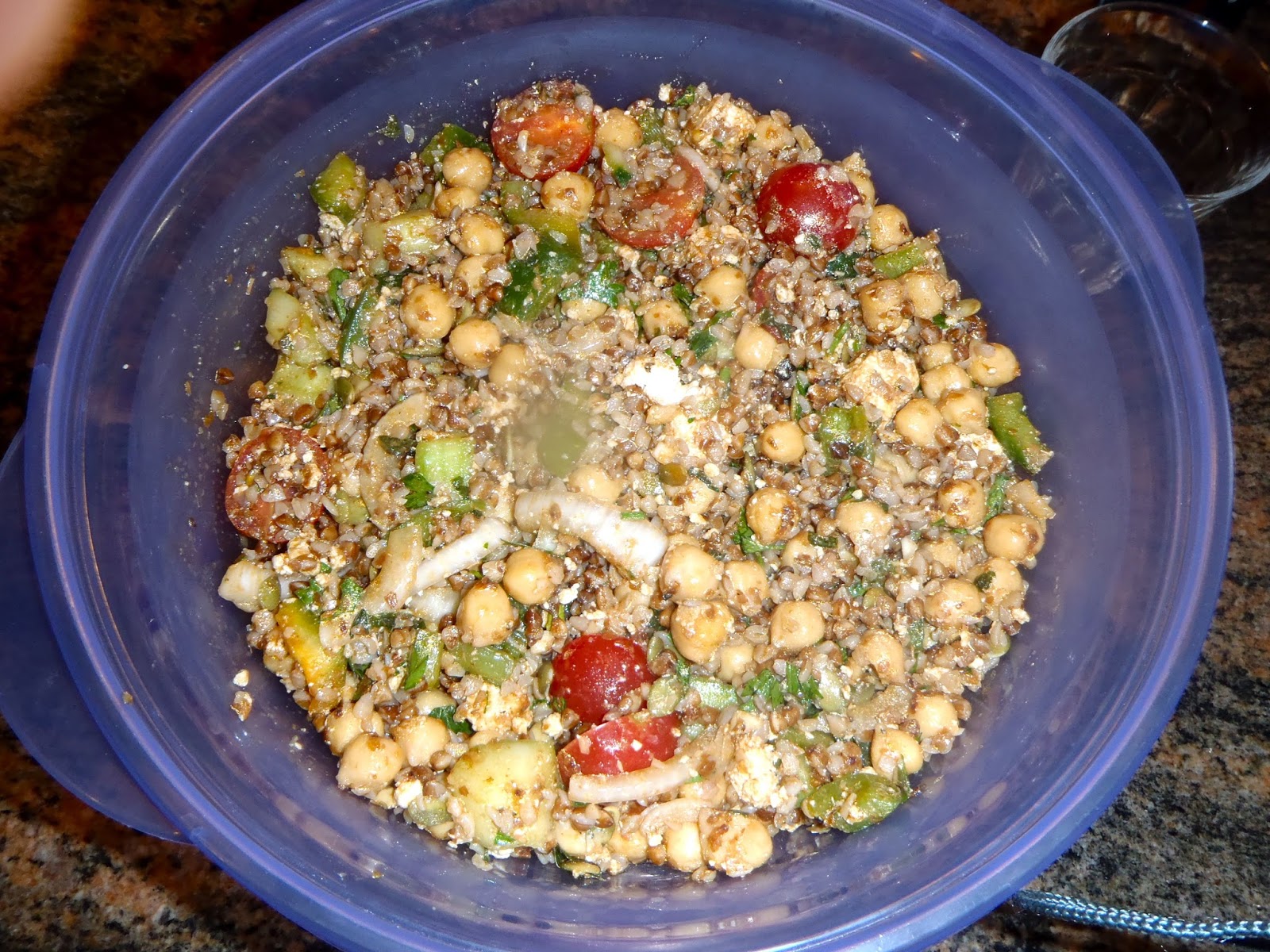
Low-Sodium Kasha Mediterranean Salad with Curd Cheese


Kasha Mediterranean, the Slovenian-inspired salad created by a Facebook friend named Josef, had become one of our favorite dishes. It is a tasty twist on a familiar salad that is normally based on bulgar wheat.  Made with buckwheat instead, it is unusual and perfect for entertaining.

A low-sodium version would be a challenge, because one of the key ingredients is feta cheese.  I resolved to try it with cubes of my homemade salt-free curd cheese, pressed and cubed, then doctored up with paprika, onion, and pumpkin seed oil.  (That recipe, a traditional Slovenian appetizer in its own right, is in the preceding post.)

Without the tang of feta, the salad tasted a little bland.  So I had to make a few adjustments: more spice and a tangier dressing.

For the recipe and the verdict, read on.


Low-Sodium Kasha Mediterranean Salad with Curd Cheese  


Salad:

1 c. dry whole buckwheat groats or kasha, cooked in
1 ½ c.  salted water

1 16 oz can of chickpeas (garbanzo beans), rinsed and drained
6-8 oz salt-free curd cheese (or paneer),  cubed *
4 small/medium tomatoes, diced
1 cucumber, peeled, seeded, and diced
1 green pepper, diced
½ c. red onion, diced (or 4 green onions)
4 T. fresh parsley, minced
black pepper, ground, to taste
smoked paprika, ½ t. or to taste


*The salad ingredients follow the original recipe, except for the substitution of salt-free curd cheese for feta. The cheese will be less bland if it is cubed and marinated with onion, paprika, and pumpkin seed oil.


Dressing (a tangier version):

2 T. olive oil
2 t. pumpkin seed oil
6 T. vinegar
juice of 2 limes
2 T. pomegranate molasses
5 cloves garlic, minced
4 T. fresh mint
1 t. smoked paprika
1 t. hot paprika
black pepper, to taste
1/4 c. pumpkin seeds


If you need more detailed directions for assembling the salad, consult the original recipe.


The verdict?  Well, the flavor was a little different, without the sharp, salty tang of feta.  But the modified salad stands up well,  especially with the intensely flavored dressing.  It's a winner and even more healthy.  Gluten-free, salt-free, and delicious!


Wednesday, August 7, 2013

Curd Cheese with Onion, Paprika, and Pumpkin Seed Oil


This simple but unusual appetizer combines three Slovenian favorites: curd cheese, paprika, and pumpkin seed oil.

I adapted it from a recipe in Janez Bogataj's The Food and Cooking of Slovenia. He calls it Curd Cheese with Onion or Koroška skuta s čebulo.  It is a specialty of Koroška (or Carinthia), a region on the Austrian-Slovenian border that is well-known as a producer of pumpkin seed oil.

Since I wanted to make a salt-free version, I increased the paprika and pepper and added a sprinkle of pumpkin seeds on top.

Traditionally, this tasty-sounding combination is served as a spread on rye bread.  But I had another plan. I wanted to use salt-free curd cheese as a substitute for feta in salads. I worried that my unadorned homemade curd cheese might be a little bland.  I hoped this flavor combination might give it just the right boost.

I made a batch of homemade curd cheese and pressed it overnight to make a firm round. The next day, I cut it into cubes and followed the recipe below.

For the result, read on.


Curd Cheese with Onion, Paprika, and Pumpkin Seed Oil (adapted from Janez Bogataj)

1 cup/ 8 oz curd cheese or farmer cheese, homemade or store-bought, salt-free
1 t. paprika
1/2 onion, finely chopped
freshly ground black pepper to taste
(salt, if desired, to taste)
1 T. pumpkin seed oil
pumpkin seeds, toasted (optional)

For a smooth spread, crumble the curd cheese in a bowl.  To use in a salad or other dish, cut cheese into cubes.

Sprinkle the cheese with onion, paprika, black pepper (and salt, if using.)  For a spread, mash and blend with a spoon.  Or, to retain the shape of the cubes (as I did), just toss the ingredients lightly. Drizzle with pumpkin seed oil.

The verdict?

This does makes a lovely spread on rye bread or whole grain crackers, especially with a sprinkle of pumpkin seeds on top.  But it also worked beautifully in my salt-free version of Kasha Mediterranean Salad.  For the recipe, see the next post.