Showing posts sorted by relevance for query Pust. Sort by date Show all posts

Monday, March 19, 2012

Mardi Gras, Slovenian Style: Blood Sausage, Potica, and Polka


I discovered the Slovenian community in San Francisco almost by accident. It might not have happened at all, if I didn't play the Cajun accordion.

One night in February of 2005, my Cajun band was playing at a little club outside San Francisco. It was Mardi Gras season, so we were dressed up for the occasion, in masks and beads.

Some dancer friends told us about an event called a "Pust" at the Slovenian Hall in San Francisco the following weekend. It was Slovenian Mardi Gras, they'd heard. A festive dinner and a polka band. They suggested my fiddler husband and I might like to join them.

Slovenian Mardi Gras? That was complete news to me. I had noticed the Slovenian Hall, a solid square building with a big "for rent" sign clearly visible from the highway, whenever we drove into San Francisco. But I had no idea it was still in operation. I figured it was one of those abandoned ethnic clubs, now just a banquet hall for hire.

My husband and I agreed to meet our friends there. We were too late to get into the dinner, but they let us in for the polka dance. It was a yearly event, we learned, put on as a fundraiser by the Slovene National Benefit Society (SNPJ), one of those old-style ethnic insurance organizations.

We discovered quite a scene. A couple hundred people had just finished dinner and were waiting for the polka band to start playing in the big room with the stage. Our friends led us into a smaller room off to the side, where some accordionists were jamming. It looked like an old-style European tavern, with paintings of Alpine vistas and rural life on the wall. We ordered a drink and soaked it all in. Once the dance started, I even let my friend talk me into dancing a polka.

(Update: Here's a great video of a more recent Pust accordion jam at the bar.)

So we went back the next year—for the Pust dinner, as well as the dance. By now, I had learned more about the Slovenian-style Mardi Gras. It bore a striking resemblance to Mardi Gras celebrations in Louisiana. Not in New Orleans, with those big parades. But more like the country celebrations of the Cajuns and Creoles in the rural communities of Southwest Louisiana. Traditionally, Cajun Mardi Gras is a male scene. Masked men in costumes, heavily lubricated with alcohol, travel around on horseback or in trucks to the neighboring homes and farms. They sing, dance, play music, raise a ruckus, and beg for contributions to the communal gumbo pot.

In Slovenia, I learned, there are rowdy parades of folks dressed up as wild shaggy creatures called kurenti, who do much the same thing. It's Carnival, the one day in the year when everything is turned on its head and the usual rules don't apply. Just like in Louisiana, there seems to be an unsettling mix of menace and good times. These two rural cultures had much in common.

Kurenti, from Wikipedia 


Here's a video of kurenti on parade in Slovenia, from the Slovenian Ethnographic Museum.
And one more, with whips and accordion music.

Now look at this clip of Cajun Mardi Gras, from a well known Louisiana documentary filmmaker.

They could be cousins!

I showed up for our first Pust dinner with high hopes. Maybe there would be wild revelry. But it didn't happen. Just a big, sit-down banquet dinner. Not even a slice of potica. And then a polka band. I wasn't even sure most of the people there were Slovenian.

But it takes time to explore a new community. We went back a few years later, for a wine festival, and discovered the cultural heart of the Slovenian Hall: The Educational and Dramatic Club Slovenia, who had organized the event. There were songs and priestly blessings, all in Slovenian. We met some delightful people, including many born in Slovenia. I was hooked.

We soon became regulars at the Slovenian Hall. And we attended many more events. We helped out in the kitchen. At one event, I was a server in the buffet line and learned a shocking truth: some Slovenians dislike sauerkraut!

As I started to notice the food at these events, I reached a few other conclusions: Festive meals were very heavy on meat, especially pork. Pork roast,  barbecued ribs,  Slovenian sausages, and sometimes chicken appeared often. Potatoes, cabbage, and sauerkraut were the usual side dishes. There was always a green salad, in a tart vinaigrette dressing. And there was always plenty of alcohol: Wine and mixed drinks for sale at the bar. Carafes of red and white wine at the long banquet tables.

Another shock: Dessert didn't always mean potica. Unless, of course, it was a potluck, when there would always be the chance to sample and compare different versions. Eventually, I found enough  courage to bring my own potica to a potluck, and was greatly relieved when it passed muster.

This year's Pust Dinner included roast pork loin, beans, tasty fried potatoes, and sauerkraut, served family style at long buffet tables. But the centerpiece came a little later in the meal.


Blood sausage is a traditional dish at Pust. A small group of people at the Slovenian Hall get together every year to prepare it. At a recent event, an older man who heads up the operation told us that the tradition might be ending this year,  because they couldn't find younger people to continue it. He tried to recruit my husband, who had to decline because the big sausage-making operation happens during the work week.

Blood sausage, I have to admit, holds little appeal for me. When it is offered, I will dutifully sample a piece. It is dark, starchy, and slightly sweet. f you look at recipes, you will discover why.  

Here's the ingredient list for Krvave Klobase from the Progressive Slovene Women of America:

1 medium pork head
1 veal lung
4 T. salt
1 1/2 T pepper
1 t. cinnamon
2 T. marjoram
1/2 t. cloves
2 lbs. parboiled rice
1 quart pork blood

The best part of this year's Pust dinner came at the end. It was potica, with a particularly intriguing filling I had never tasted before. It included nuts, but the flavor and texture seemed different. It had a strong taste of lemon.

Later on, I met the young woman from Fontana whose family had catered the event. She seemed pleased when I complimented her on the potica. She recited a long list of ingredients, which included lemon and vanilla. So I had guessed right. Not quite like the traditional version of potica my family makes, but tasty just the same.


Wednesday, March 11, 2015

Extra-Light Baked Flancati for Pust (the rough puff Mardi Gras version!)


Ten years ago, thanks to some Cajun music friends, I made two belated discoveries: Slovenians have a traditional Carnival celebration called Pust. And San Francisco has a small but active Slovenian community, centered on the old Slovenian Hall in the Potrero Hill neighborhood.

I don't know which one was the bigger surprise.

(To learn more about Pust in Slovenia and San Francisco, see Mardi Gras, Slovenian Style: Blood Sausage, Potica, and Polka, my 2012 post about the holiday.)

Traditional Pust dinner with blood sausage, Slovenian Hall, SF

Now, a decade later, I have become a regular at the Slovenian Hall. Especially since I started taking weekly language classes last year.

When Carnival time rolled around last month, I decided to organize an impromptu celebration for our Slovenian class. Traditional foods for Pust include two sweet treats: krofi, or jelly-filled doughnuts; and flancati (sometimes called pohanje), the beignet-like pastry strips my grandma called angel wings. But I wasn't prepared to do any deep fat frying, even in the interest of preserving ethnic food traditions.

Then I thought of the perfect alternative to fried pastries: my baked flancati recipe, adapted from  a Slovenian American cookbook. It had proven to be a dependable stand-in for the fried version I remembered from childhood, with the same fanciful shapes and heavy coating of powdered sugar.

But I had a small problem, this time around. Since this was a last-minute undertaking, I'd had to skip the the usual overnight refrigeration. After just an hour in the fridge, my flancati dough seemed too soft. In trying to correct this, I ended up with a new twist on baked flancati.

Here's what happened: I knew the pastry would become tough if I tried to knead in more floor. So I decided on a more gentle approach. I rolled out the dough on a well-floured board, folded it in half, and re-rolled it. As I worked, I had a hazy recollection of some baking technique I had read about before, but had never actually tried.


Those last-minute flancati turned out just fine. In fact, they were lighter than usual. Still, I wondered how they would be received in my Slovenian class that evening--especially by my teacher and her husband, who had grown up in Slovenia. What would they think of this American shortcut?

My teacher Mia said the flancati made her feel nostalgic. After I confessed that my flancati were baked rather than fried, her husband assured me that he was very familiar with this style of the traditional pastry.

"We call it 'light' flancati," my teacher's husband said. Then he added, "I know how you made it. You had to keep rolling and folding, right?" His eyes twinkled.

How on earth did this distinguished Silicon Valley engineer know about the fine points of pastry making? One thing seemed clear. I had stumbled onto a legitimate Slovenian flancati variation, and not just some American adaptation. In fact, a little research revealed that my "roll and fold" creation was similar to a well-known technique called rough puff (or blitz puff) pastry.

Traditional puff pastry is a laborious process that can take three days. The butter is rolled into a single flat layer and encased in two layers of dough. Multiple rounds of careful rolling, folding, and chilling follow. The end product is a rich dough with anywhere from seventy to seven hundred layers. During baking, steam from the melting butter creates the "puff" that produces those multiple airy layers. 

In the shortcut "rough puff" version, cubes of butter are combined with flour and formed into a rough dough. The butter chunks are flattened during rolling and re-rolling. The result is a rich, flaky pastry with an impressive rise, even if the layers aren't quite as numerous or discrete.

Unlike puff pastry, flancati dough includes eggs and sour cream. But otherwise, I had unwittingly followed the same approach.

Now that I understood what I had been doing, I was eager to make this rough puff version of flancati again.  I had the chance a few weeks later, for another event at the San Francisco's Slovenian Hall.

This time, I made a few changes to maximize the puff. I was careful to leave the butter in visible chunks when I cut it into the flour. I chilled the dough overnight. And I followed a more deliberate folding and rolling technique, described and illustrated below. To bake, I used a slightly higher oven temperature.

The result was the best flancati yet. Even my grandmother would have approved!


Extra-Light Baked Flancati

2 cups flour
1/2 lb butter, unsalted, cut in chunks
2 egg yolks
1/2 cup sour cream
1 T. rum
1 packet vanilla sugar (or 1 t. vanilla extract and 1 t. sugar)
1 t. grated lemon rind or 1/4 t. nutmeg


Place flour in a medium-sized bowl and cut in butter chunks until they are the size of large peas. In a small bowl, mix egg yolks, sour cream, and flavorings of your choice until well blended. Add to the flour-butter mixture. Combine and mix lightly with your hands until a rough dough forms. Bits of butter should still be visible.

Divide dough into four balls. Flatten into thick squares, wrap in plastic, and refrigerate overnight.

When ready to bake, remove one piece of dough at a time from refrigerator.  Let soften until it can be rolled out.

On a floured board, roll out dough into an 8 or 9 inch square--or, if you prefer, a rectangle of similar dimensions.

Fold the dough into overlapping thirds, as though you are folding a letter to place in an envelope.


Flatten slightly with a rolling pin and roll out until you have another rectangle. The pieces of butter will be visible.


Once again, fold into thirds and turn the "letter" a quarter turn to the right.


Roll it out again into a rectangle, fold into thirds, make a quarter turn to the right. For the third and final time, roll out the folded "letter" into a rectangle.

At this point, you will have created twenty-seven layers of dough!


Cut the rectangle into sixteen pieces. Make a slit in the center of each small rectangle. Pull opposite corners part way through the slit. Or pull an entire side through the slit. For more detailed instructions about shaping (with photos), see my original baked flancati post. 

Place flancati on a parchment-lined baking sheet. Repeat with the remaining three pieces of dough. You will need two baking sheets.

Bake at 375 degrees for 10 to 15 minutes, until medium brown.

Remove to racks and sprinkle with confectioner's sugar while still warm.

Enjoy!


Sunday, April 3, 2022

Traditional Potica for Pust (with a few twists!)


I felt fortunate indeed to attend not one but two in-person Pust celebrations this year. The first one was a small at-home gathering I hosted for a couple of friends (and spouses) from Slovenian class. My contribution was the Mardi Gras King Cake "pustica" hybrid I had created for my husband's recent birthday. 

The second was a large outdoor gathering sponsored by the Slovenian Hall in San Francisco. It was a festive affair at a lovely private home in the Oakland Hills, with live music (we were happy to join in) and plenty of food. For that one I contributed the last of the Christmas potica I had stored in the freezer, after the planned trip to gather with family in New York never materialized, thanks to Covid. 

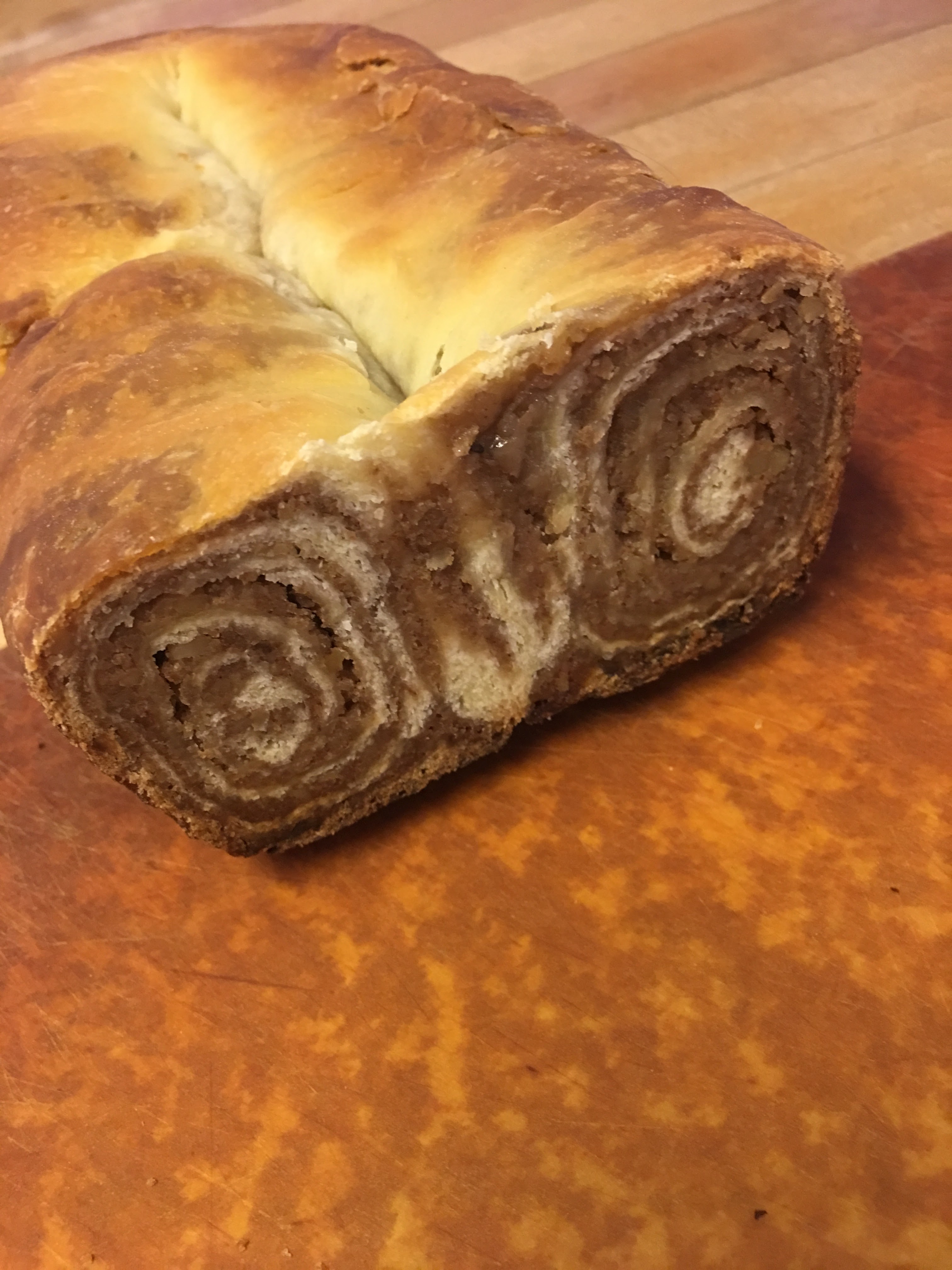
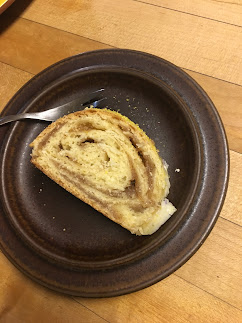
In December, I had baked two varieties of my mostly-traditional holiday potica. My standard walnut-honey potica followed the family recipe with just one small change. I used my KitchenAid stand mixer to make the dough and had not been completely happy with the results. The dough rose even less than usual and the layers seemed a little dense and damp after baking. But the potica seemed to have improved after freezing. I was particularly happy with the way the final loaf (on the left in the top photo, and also below) had turned out. On a whim, I had decided to bake the last loaf in the batch as a double roll in a bread pan, instead of doing my usual free form single roll.

The second version  (in the top right photo) was definitely an innovation. It was my first successful attempt at using the artisan-style method of cold bulk fermentation to make potica. It was dairy-free. And I added a little apricot to the walnut filling. Recipe to follow! 


Monday, February 28, 2022

New Orleans King Cake + Potica Filling = Pustica, or Mardi Gras Potica!


What happens when a dedicated potica baker decides to make her first-ever New Orleans Mardi Gras king cake for her husband's birthday? And then he suggests that she take advantage of the leftover walnut potica filling in the freezer.  

Here's what happened last year at our house: We seem to have created the world's first Mardi Gras Potica! One of my friends from Slovenian language class even gave it a new name: Pustica! (To learn more about Pust, the Slovenian version of Mardi Gras, you can read my Mardi Gras, Slovenian Style post, from the early days of this blog.)

For many years in my family, we have celebrated a cluster of February birthdays with Mardi Gras king cakes from Louisiana. Last year, because of pandemic shipping challenges, I decided it was time to try a homemade version. I never intended to do something transgressive, although it did occur to me that poticas and king cakes both use what is technically a brioche dough. Once I decided to use the same walnut-sugar cinnamon filling we use in my family's version of potica, I imagined that this homemade king cake might taste a bit like Slovenia's most famous dish.

But I never imagined how closely that slice of king cake would resemble potica. A rather strange and gaudy potica, with those bands of gold, green, and purple sugar. And with thicker layers of dough than I would normally make. And who ever heard of a potica with confectioners' sugar icing?


with marzipan filling 
with walnut filling 


But it was good, no doubt about it. So good that I repeated it again this year. This time, at my husband's urging, I tried a marzipan filling. Although it tasted wonderful, it was too thick to spread easily, so for now I would recommend the tried-and-true walnut version. 

One other twist to this unplanned hybrid: For the dough,  I wanted to use the artisan bread approach I discovered just before lockdown and have been using ever since. I was happy to discover that a blogger named Cynthia had already adapted a challah recipe from the newest edition of  "Artisan Bread in Five Minutes a Day" to prepare a very authentic-looking king cake.

For details, see the recipe below. Or use your own favorite potica recipe and see what happens if you add all those special New Orleans touches. And don't forgot to add that little figure of a baby. Whoever finds it is supposed to bring the king cake to the next party!


New Orleans King Cake + Potica Filling: Pustica! 

The artisan-style dough I used is adapted from a king cake recipe in Cynthia's blog What a Girl Eats.  She describes it as an adaptation of one of the brioche varieties (actually a challah recipe) in the new edition of Artisan Bread in Five Minutes a Day. The walnut-honey filling is from my family's potica recipe. 

Dough
1 cup milk, lukewarm
1 package yeast
1-1/2 teaspoons salt  
2 large eggs, beaten
1/4 cup honey
1/4 cup butter, melted
3-1/2 cups all purpose flour 

Filling 
2 cups finely ground walnuts
1/3 cup sugar
1 teaspoons cinnamon
pinch of salt 
2 tablespoons melted butter
2-3 tablespoons honey

Icing
confectioners' sugar
warm water 
vanilla

Decorations
purple, green and gold sugar
King Cake baby (or substitute an almond) 

For the dough: Combine all ingredients except flour in a large bowl or lidded container and mix until well blended. Gradually add flour, mixing by hand until dough forms a soft ball. (Note that dough is not kneaded in this "artisan" approach.) Cover loosely and let rise for 2 hours or until dough doubles in size and then flattens out. Dough can be used right away but will be better if refrigerated for a few hours (or as long as 5 days) before rolling out and filling.

To roll out: Roll the chilled dough into a 1/4 inch thick rectangle. If you use all the dough, you will have a 12 x 18 inch rectangle--and a very large king cake. The first time I made this, I set aside about a quarter of the dough and rolled the rest into a 9 x 12 inch rectangle. (The remaining dough can be used to make small brioche rolls.) 

To fill and shape: Follow the method described in my family potica recipe: Combine the walnuts, sugar, and cinnamon. Brush the rectangle of dough with melted butter. Sprinkle the walnut mixture on the dough and drizzle with a little honey. Roll up the dough from one of the long sides of the rectangle. Shape the long roll into a circle and join the ends together. Place the round (seam side down) on a greased or parchment-lined baking sheet. Cover and let rise for 45 minutes. Bake at 375 degrees for 35 minutes. Let cool.

To decorate: When cake is completely cool. spread/drizzle it with a thin confectioners sugar icing and decorate with alternating bands of green, gold and purple sugar. (You can purchase sanding sugar in Mardi Gras colors or make your own with food coloring.)   

For the final traditional touch: After baking, slip a small plastic or ceramic figure of a baby into the cake. Whoever finds the baby is supposed to supply the king cake for the next Mardi Gras party! 


Thursday, March 22, 2012

Slovenian Dinner Week 7: Stuffed Pepper Odyssey


Menu
Stuffed Peppers (Nadevana Paprika)
Coleslaw
Braised Broccoli and Kohlrabi

I grew up eating stuffed peppers, but I had no idea this might be a Slovenian dish, until I found recipes in all three of my vintage cookbooks.   I'd thought of it as Tex-Mex, probably because my mother referred to the meat-rice filling as Spanish rice.

I continued to wonder if it might be an American dish, until a conversation at last week's Pust dinner at the Slovenian Hall in San Francisco.  I'd been describing my new cooking venture to one of the men there.  He listened with interest when I mentioned the first dish I'd tackled, stuffed cabbage.  Back home in Slovenia,  he said, it was even more common for their family to have stuffed peppers.  So now I knew for sure: this dish was legitimate!

In those mid-1950s recipes, the seasoning did seem a little bland, just salt and pepper. Some online searching turned up a few Slovenian recipes with paprika and garlic, so I felt I could justify that addition.  I drew from all those sources to come up with a final recipe for stuffed peppers with tomato sauce.

But first, it was off to the big produce market around the corner to buy some peppers. This time, I took my camera.  Once again,  I was seeing our familiar neighborhood market with fresh eyes.  I felt enchanted by the beautiful shapes and jewel-like colors of the vegetables:


I picked out an assortment of organic peppers:  red, green, yellow and orange.  And then, just for fun, I picked up a handful of baby peppers:


Back in my kitchen,  I admired my wares.  I arranged those bright, shiny peppers in a glass bowl:


Then, my imagination took over.  I arranged them as a pepper family.  Papa, beaming at Mama beside him, with the baby peppers gathered in front.


Enough whimsy!  Time to get to work on dinner.


Filling:
1 1/2 lb. ground meat (turkey, pork, and beef mix)
1 large onion, chopped (1 c.)
1 large clove garlic
1 t. paprika
1/4 c. rice, parboiled
1 egg
1 t.salt
1 t. pepper
olive oil for browning

Sauce:
28 oz. can ground peeled organic tomatoes
14.5 oz. can organic diced fire roasted tomatoes
1 t. paprika
2 t. brown sugar
1 t. salt
1 t. pepper
remaining 1/4 c. onion/garlic mix

4 large peppers, assorted (1 red, 1 green, 1 yellow, 1 orange)

For filling: Brown chopped onion and garlic in a little olive oil and reserve 1/4 c. of mixture for sauce.  Parboil rice in boiling salted water for 10 minutes. Drain. Mix meats, seasonings, egg.  Add onion/garlic mix and rice.

For sauce: Mix all ingredients together and simmer for 15 minutes.

Stem peppers, cut in half lengthwise, remove seeds and membrane.  Rinse and drain. (You might want to parboil, although I didn't.)

Put a little sauce in bottom of oiled rectangular baking pan. Divide filling among pepper halves. Pour sauce over peppers.  (You will have sauce left over.) Cover and bake at 350 degrees for 1 hour, or until tender, adding sauce or other liquid if needed.

The verdict: A very tasty filling and sauce, and not at all like Spanish rice.  The dish was suffused with the flavor of Central Europe and the Balkans.  The peppers were a little on the firm side, although the bright colors were preserved.  Next time, I might parboil the peppers, cover them completely in the sauce, or try the stovetop simmering method used in one of the cookbooks.

Update:  Eight months later, I did a makeover:  I parboiled the peppers and created a healthy turkey-kasha filling.  It was even better!  It's here, if you'd like to take a look.


Before Baking


Stuffed Pepper, Coleslaw, and Broccoli 

Saturday, February 2, 2013

Slovenian Dinner Week 44: Healthy Sauerkraut with Potatoes and Smoked Turkey Bits


Menu
Sauerkraut with Potatoes and Smoked Turkey Bits
Green Salad


It was the second Tuesday in November.  I had a busy day ahead and hadn't given much thought to dinner.

As my husband was heading out the door, he dropped a few hints.  We had a nice jar of organic sauerkraut in the fridge. And, since he figured I would be going to the butcher shop, perhaps I could order the turkey for Thanksgiving.

Sauerkraut and turkey.  That planted a seed. And it fit right in with a question that had been on my mind, as my year of ethnic cooking was coming to a close.

Is traditional Slovenian cooking healthy?

Yes and no.

No worse, probably, than any other cuisine that evolves in times of scarcity, when people do hard physical work.  Especially in northern climates in the past, when people were limited to whatever was in season—or whatever they had managed to preserve.

That is the beauty of sauerkraut, a staple in so many Eastern European cuisines. Served fresh, cabbage is a healthy food.  But it is easily preserved through simple fermentation, rather than canning.  More and more, we are coming to recognize the health benefits of fermented foods.

But there is no denying it: Many elements of traditional Slovenian cooking make a contemporary health conscious cook cringe.  It is heavy on meat, primarily pork. The fats aren’t the healthiest: lard, cracklings, bacon fat, and butter.  And so many of the famous delicacies (potica,  homemade noodles, struklji,  zlikrofi, dumplings) are based on white flour.

But I knew that it was possible to do healthy makeovers.  I had been doing it myself.  From the beginning of my cooking project, I used olive oil in place of other fats, except for baking.  I was pretty sure that contemporary Slovenian cooks were doing the same thing. The Slow Food movement is big there.  A recent president was a vegan, for heaven’s sake!

So I started hunting around on the Internet for healthy-looking Slovenian recipes with sauerkraut. I  found the perfect example:  Potatoes with Sauerkraut and Crunched Smoked Turkey Ham, a modern adaptation of a traditional Slovenian dish.

The recipe was on a blog I had seen once before. Indulging Life is the creation of a Slovenian woman named Mateja, who now lives in the United States. Her blog is stylish, beautifully photographed, and with a fair share of luscious desserts and clever food adaptations.  She would have fit right in at the recent FoodBuzz Blogger Conference I attended.

This looked like a simple dish, similar to some I had already made, and with the same sorts of substitutions: turkey and olive oil instead of pork and bacon.  It even included garlic, not always a part of traditional Slovenian cooking. I was intrigued by Mateja's suggestion that cooking potatoes in the sauerkraut pickling liquid prevents them from getting mushy. I had never thought about that.

This dish looked simple and tasty. It had an elegant presentation—and it was validating, to have a Slovenian cook doing healthy makeovers while still holding on to her traditions.

I already had a few ideas for a some tweaks I might make: Small, multicolored organic potatoes, with the skins left on.  And maybe a few juniper berries and caraway seeds, my usual addition to sauerkraut.  I’d learned about this from a recipe on the Slovenian government’s tourist website, so I know it was legit!  And probably less oil.

When I went to the butcher shop around the corner, I encountered a problem: No turkey ham, much to my surprise.  The man behind the counter suggested smoked turkey breast would work just fine.  But I thought it would be better to combine it with turkey bacon, so I bought a few thick slabs of both.

This would be an easy dish to prepare,  I thought.

And it was, except for a fight to the death with that jar of sauerkraut!  I couldn't seem to open it. Not even with that special rubber gripper, tagged with the logo of a Slovenian fraternal organization that I had picked up at a Pust celebration a few years ago.  I tried tapping the lid with a knife.  Holding it under running water. Twisting with the help of a rubber band.  Nothing worked.  I was desperate.  Finally, a brainstorm: I used a can opener to punch a hole in the top of the metal lid.  There was a whoosh as the seal broke.  By then, of course, the potatoes had practically boiled dry, so I had to add more water and start over.

No matter. It all worked out.


Below is my adaptation, roughly double the quantities in the original recipe, which is supposed to serve two. Along with the addition of juniper berries and caraway seeds, I increased the garlic.  That part was my husband’s doing.  I had asked him to chop up two cloves.

“Oh, these are small,” he said.  “I’ll do four or five.”

I couldn’t bring myself to use a half cup of olive oil, so I cut it way back.  And I used that turkey breast-plus-bacon combination instead of turkey ham, out of necessity.


Sauerkraut with Potatoes and Smoked Turkey Bits (adapted from Mateja)

1-1/2 lb. assorted fingerling or other small potatoes, unpeeled
1 quart (32 oz) prepared sauerkraut, with liquid
1 t. salt
1 t. black pepper, freshly ground
1 t. juniper berries
1 t. caraway seeds
1 lb. (2+ cups) cubed, smoked turkey breast and turkey bacon (or use turkey ham)
4 small garlic cloves,  finely minced
1/4 c. olive oil  (note: half what the original recipe called for, so increase if you like)

Wash potatoes well, leaving skins on.  Cut larger potatoes in half.  Place in large pot, add water to cover, add seasonings, and bring to a boil. Add sauerkraut with liquid, combine, bring to a boil again, then lower heat and simmer uncovered until potatoes are tender. Most of the liquid should have been absorbed or cooked off. Cover and keep warm.

Heat olive oil in large skillet.  Add turkey cubes and cook, stirring occasionally,  until they are “browned and crunchy," as Mateja says.  Add garlic for the last few minutes.

For serving: place a portion of the sauerkraut-potato mixture on each plate,  Top with a portion of the turkey cubes with that nice garlicky oil.  Enjoy!


The verdict:  Very good.  It could probably use even more smoked turkey. Or maybe it’s just that I added some of the extra sauerkraut that was left in the jar.  I'm glad that I spiced up the sauerkraut.

As for the topping:  The original version is probably even tastier, although higher in fat. Next time, I will probably try to use all turkey ham or turkey bacon, and skip the milder turkey breast.  If I am feeling Indulgent :-) I might also add more olive oil.  Using the full amount will turn the cubes into deep-fried little "crunchies," as Mateja calls them.

All in all, this is an easy, elegant, healthy version of a traditional Slovenian flavor combination.